Thursday, January 20, 2011

Studying Broads

The first time I studied abroad, I made it three and a half miles with four sandwiches and a change of clothes, which is to say that I was thirteen  running away from home. I bring this event up because I think that we all tend to forget how valuable those first unaccompanied steps outside of our homes were, how much they put this fragile little world into perspective. I was like Siddhartha come out of his palace to see the world with all its blemishes and spots. The event left me with a profound wisdom that I would like to pass on: one does not have to travel well or very far in order to experience substantial change. Perhaps, this is true now more than every before. Digital media is shortening the distance between image and experience even more than my thirteen year old self could have imagined, and the result is not necessarily a good thing.

Before a student even gets to their host country, they are so bombarded by digital imagery and text that is hard to tell how much this tampers the process of true cultural inundation. From Facebook to Café Abroad students ask about where to get X at the abroad site, whether or not you can wear Y, how others evaluate classes at the local university, the sort of host family experiences to expect and so on. Their experiences become highly regulated, not only as academic oversight and safety precautions increase, but also as cultural encounters become over-documented and readily available out of context in both virtual and other sites not attached to the locality where students will study
.
Even that catalogues produced by institutions of higher education to promote genuine abroad experiences aid in this cheapening of experience. Catalogues respond to the needs of stakeholders – universities, parents, students – by promoting messages that: 1) comply with good business policy, articulating what goods (experiences) will be delivered for what price; and 2) communicate necessary tenets, for example as the Harvard Catalogue says, that "the best way to develop...global competence is to have firsthand experience living abroad" that studying abroad will help you "develop a deeper understanding of their own society" and that ultimately "planning to spend time abroad is one of the most exciting things you will do." These catalogues also reveal what one can expect to see, which means that anomalies, ephemeral experiences and exceptions to the cultural rule, some of the most important parts of any journey abroad, must invariably be kept out.

If, however, all of this changed when a student finally got abroad, my concerns would not be so great. However, what is intriguing to me is that this digital bubble that technology and image has made around us seems to shatter little, or at the very least not enough, upon actually cultural engagement. Karen Rodríguez, PhD and director of the CIEE Study Center in Guanajuato, Mexico says that "too many students come abroad only to spend their time tightly wired into Skype, the Internet and Facebook, seemingly more concerned about capturing images for those at home than actually experiencing the wonders at their fingertips." Students spend an average of 1440 minutes on a cell phone daily while abroad, an estimated 1250 minutes daily looking at the world through the lens of a digital camera, and almost 2800 minutes listening to an ipod. This digital desensitization is causing Rodríguez how much time students actually spend abroad.


All of this digital inoculation has me questing what exactly it means to study abroad in the digital age. If it means getting outside of your comport bubble, then should not we all leave our cell phones and laptops at home? If it means getting a new perspective, then should not we attempt to get a perspective on our own lives before we burden another society with our bias? And if it means, as  it traditionally has, that studying abroad is meant to help you experience a new culture,  then I have to ask how much of this is even possible in an era so dominated by globalization and global identities, where English is spoken as the number one language on the WORLD wide web and 47 million McDonalds customers every day?

If studying abroad is going to continue, it has to reinvent itself within its digital confines. Experts in the field are pointing to what they call digital story telling, short, first person narratives, often video narratives created by combining recorded voice, still and moving images, and music or other sounds.  Karen Rodríguez notes that "while digital storytelling does not embody or ensure critical intercultural thinking, I argue that it has a tremendous potential for re-creating both students and host community members as authors and representers of their experiences, thus creating a 'counter-catalogic' study abroad experience that goes far beyond the staid images used to market these experiences." The idea is not new or novel; many students keep blogs while studing abroad. But tweeking this method to incorporate a further developement of experience could potentially be a leap forward, a judo on the digital invasion. Check out the blog for the USC Study Abroad Program in Barcellona to get a look at what this might mean here.

Beyond Shades of Black

No matter how many times grandmothers advise not to, people will always judge a book by its cover. In our hectic world making snap decisions is almost necessary, therefore arguably the most important project for an architect to design is himself. How you present yourself reveals everything about your personal philosophy, work ethic, and design methods. Designers almost have a duty to send a statement through their wardrobe. This duty cannot be taken lightly so when you look through your trendy lensless frames into your closet, ruffle through the sports coats, the Armani suit, and the graphic T’s to find what image you wish to exude.

The stereotypical architectural attire is designed to eliminate any possible distractions from one’s work. This wardrobe has a nearly superman-esque uniformity and will not stray from the color black, from the silk button down to the matte loafers. With this uniform, the architect is able to become invisible; fading to the background so that the presenter will not detract from the fruits of their labor.

Despite this most venerable attempt at professionalism, this camouflage has one obvious and detrimental side effect: causing the wearer to blend in. Every architect’s desire is to make a name for their self and this strategy seems to go in the opposite direction: towards oblivion.

On the opposite end of the architectural spectrum lies the salesman, sporting the neatly pressed designer suit and power tie. This mimicry of professionalism gives the perception of competence and professionalism: a designer you can trust.

The third school of architectural fashion allows the wearer a more unique route. This line of designers have, at their fingertips, an infinite number of choices from Bright Colors, Outlandish Patterns, Expertly Placed Accessories; finding your own path can provide a powerful image and

So when you suit up, consider the yarn that your wardrobe is spinning for your audience of thirsty onlookers. Remember, you are representing the long tradition of the most noble profession. You need to stay on the cutting edge and compete with your peers through all means possible. You need one more thing to worry about in your already overly stress-filled profession.

Designing to the Deathbed?

Architecture is an old profession, but its practitioners are even older [in relative terms]. The
youngest winner of the Pritzker Prize thus far was Richard Meier at 49. Another recipient, I. M. Pei, is still
actively designing where most nonagenarians would have gladly doddered their way into retirement. It is
common knowledge that most architects do not become established until well into middle age, a
phenomenon that has been remarked upon to the point of becoming a punchline (fill in your own: “Why
are architects so old?”), but answers as to why it has come about have been few and far between.

To answer these questions, it is important to peer beyond stereotypes; surely, the roots of this
relationship lie deeper than the inexplicable feelings of ease that come upon clients while conversing
with grandfatherly figures sporting thick-framed glasses and a weary tousle of snow-white hair. Like the
design process itself, the search for this reasoning is unending in its scope. While it is impossible to
individually ascertain what happens to an architect’s brain as it crosses the gorge between carefree
youth and stately age [, presumably on a bridge of their own devising], there is no question that the
lessons granted by life lend themselves to certain trends in thought.

Do these changes manifest as the brain undergoes physical development? When examining an
end product, to what extent does the presence of an older hand differ from that one half its age? The
former might begin to tremble a bit more while sketching the ghosts of multiple decades, but its function
does not change over time.

But doe the marks derive from the richness of lived experience more than crow’s feet? Does the
variety of experiences come from age, or changes in geography?

Perhaps the answer lies in the shift of the priorities that come and go with each step in the life
cycle. Do the arrival and departure of responsibilities of career, home, and family have a discernible
effect on the design process?

Saturday, December 18, 2010

Fall 2010 Final Presentations Sneak Peek

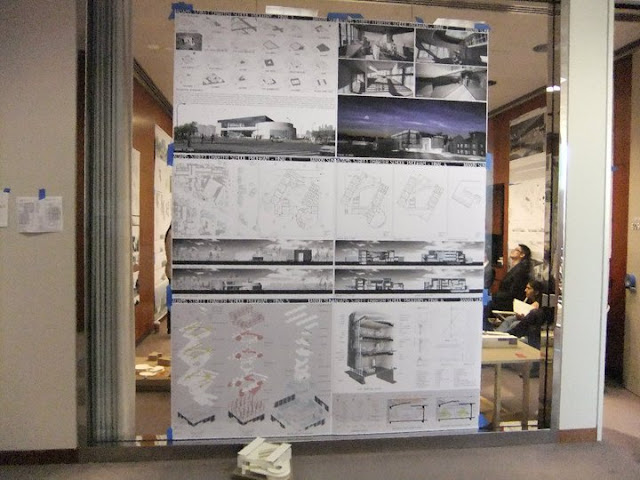
Here's a brief overview of what was happening at the USC School of Architecture final reviews (12/13/10 & 12/15/10), on the 51st floor of Paul Hastings building in Downtown LA.
From first year to grad, there was a variety of projects: clothing design, buildings, food trucks...
 
all photos by Fiona Siu


more to come!

Tuesday, October 19, 2010

Intangible Architecture: Forming Space with the Immaterial by Christina Hwang

According to Reto Meier, in his recent article, The Future of Mobile: Invisible, Connected Devices with Infinite Screens, there will soon be "contact lenses that project a visual feed directly onto your retina" over the current "high resolution screens, tablet devices, and HD output from mobiles". Additionally in twenty years, "you [also will be] the computer", over today's "lighter, thinner devices that last longer". It seems as though people idealize the age where physical effortlessness is quintessential, thereby making the tangible obsolete. As technology becomes more compact and virtual, it only seems to make sense for the architects to jump on board as well and at least make the effort of searching for a virtual solution. Although currently, tangible material is the most obvious solution to space-forming, we should envision the future and embrace immaterial processes in constructing architecture as well.

Throughout history, the definition of architecture has been varied in many ways. These variations occur not just outside of generational and geographical barriers, but also within the same backgrounds and learning environment. Whatever these definitions are, most will agree that the term architecture somehow deals with designing of a space. Thus far, the most obvious solution to manipulating that space has been through the means of a tangible material. But these advancements and diminishing desire for material for the future, have compelled architects to now reconsider the allowable means of manipulating space outside of its typical boundaries. This idea of intangibility in architecture, however, is

light.jpg
nothing new, as shown with architecture that is shaped by elements such as light and sound, shown on the image to the right. It is simply the reality that people can experience space and become so affected that they move and progress through space under its influence.This is the reality of architecture. Architects not only already manipulate spaces with the intangible, but more so they believe it is essential that those elements are used to enhance spatial experience. It therefore would not make sense to not explore these potential intensifiers.

In response to the predictions of Meier in the beginning of this entry, MIT Technology Review has responded with some fulfilled realities and promising futures. In response to his 20 year screen prediction, author Mims writes, "transmitting images to such displays will be non-trivial. Wouldn't it be easier to simply perfect augmented reality specs?" It shows we are closer to these "future age" than we think and that most of the world looks forward to them with open minds. Keiichi Matsuda, the creator of the Augmented (hyper)Reality: Augmented City 3D shown in the video below, asserts that "the architecture of the contemporary city is no longer simply about the physical space of buildings and landscape, more and more it is about the synthetic spaces created by the digital information that we collect, consume and organize; an immersive interface may become as much part of the world we inhabit as the buildings around us." This is the reality of the world today. Engineers and scientists not only work to manipulate devices but are promoting manipulations in reality, shaping and molding space as well.

In the remote future, investing in immaterial means of spatial manipulation could also be the "sustainable" solution that so many architects share a concern for. There is an abundance of surplus building material companies, at the hope of recycling and reusing the unused; this clearly expresses just how much of these "excess materials" are remaining. Afterall, who would actually desire used/recycled materials and anything not-new, if the new had zero negative impact on the environment? Though this statement seems far-fetched now, we look to the bright future of naturally generated energy, which generates virtual realities far more sustainably than constructing and forming in materials.

Technology is moving forward to enhance our lives in every possible way. Likewise, architects should utilize these advancements to enliven the spatial qualities. Not only have architects throughout history, dealt with intangible materials such as light, sound, and even taste to shape spaces, but this is the future of the human race: "instead of disembodied occupation of virtual worlds, the physical and virtual are seen together as a contiguous, layered and dynamic whole. It may lead to a world where media is indistinguishable from 'reality'. The spatial organization of data has important implications for architecture, as we re-evaluate the city as an immersive human-computer interface" It may, in the long run, prove to be the ultimate sustainable means, generating little to no harm to the environment. Ultimately, architects should explore outside of their comfort zones of dealing merely with the tangible. They should progress with the rapidly changing technology, not limiting themselves to the sense of touch to mold a space. And likewise, when exploring these immaterial fields, they should not neglect the physical and tangible world nor view them any inferior, just as all of the senses that a human being possesses are equally important in different ways.

Sunday, March 28, 2010

Autotecture by Taylor Cornelson

“I got 99 problems, but my pitch ain’t one.”

Autotune is considered by many to be the downfall of the music industry. In case you’re not familiar, this seemingly-revolutionary technology is something which is used in contemporary music – especially pop music – on an alarmingly regular basis. Initially released in 1997, Autotune has actually been around for a very long time. It’s used mostly by contemporary artists – think Cher, Britney Spears, T-Pain – to alleviate vocal warbles and disfunctions encountered in the recording studio. Sonically dysfunctional samples come in one end, and pitch-perfect melodies emerge from the other. While Autotune has been the secret behind many hit singles in the past, it is only now gaining attention as a destructive force in the music industry.

Indeed, autotune has come under fire recently for its corruption of the music industry by removing much of the “talent” of vocal performance. No longer does a platinum-selling signer need to exhibit any of the traits normally associated with talent; autotune gives any American Idol reject the voice of a trained professional. This paradox of talentless perfection continues to fuel controversy – why use this technology if it removes the only prerequisite to becoming an incredible vocal artist? Doesn’t mechanized perfection remove a sense of artistry and honesty from this once-venerated craft?

Though this particular debate is something from which many architects are far removed, a similar technological revolution is happening in architecture today. Advancements in Computer-Aided Design (CAD) and Building Information Modeling (BIM) have given architects an ability to execute mechanized perfection of design on a broad scale – from creating sensuous curves with a single loft to generating intricate tectonic details en masse. Indeed, these technologies remove the personal search for artistry and replace it with computer-generated perfection.

This embrace of technology assumedly presents architects with the opportunity to expand their craft into the digital realm, alleviating the painstaking repetition once associated with building design. No longer must designers slave for hours in darkened rooms drawing window schedules or draft forty sections to explain a complex curve; the power of the computer reduces these menial tasks to a script which takes mere seconds to execute. Designers are now free to invest their time in meaningful design work, and to see the outcome of their choices without laborious interludes of production. Perhaps no better is this power exhibited than 3D printershours of delicate model building are curtailed to a single print command. The process is painless, and the results exhibit an unparalleled level of craft.

These advantages have spawned the propagation of digital design and production in recent years – but at what cost? Like Autotune, the digital production of architecture has a tendency to “iron out” details which would normally require careful consideration of the architect in question. Autotune – while producing ear-pleasing results – requires a dramatic reduction in traditional artistic talent from the vocalist. Similarly, computer-aided design requires a marked reduction in what fifty years ago would have been considered some of the fundamental artistic merits of an architect. Pen and paper have almost entirely been replaced with screen and mouse. No longer is an architect’s vision limited by his ability to communicate design by physical means – it is the creation and manipulation of digital content which now proves king in the architect’s toolkit.

While many would argue that this shift from physical to digital removes much required talent from the design process, I would argue that it is merely a natural progression in the means by which architects communicate their intention. Though CAD and BIM eliminate some of the traditional challenges involved with the production of a finished design, they largely shift focus from more traditional focuses of tectonic design towards the increasingly experimental as found in the contemporary architectural world. While not immediately apparent upon their introduction, the integration of CAD and BIM have sparked a renewed emphasis on language of design throughout the contemporary architectural practice. This shift is seen in the emergence of increasingly complex forms and design techniques – "lofted" surfaces, sweeping forms, complex curves. Aspects of a building’s construction, such as the delineation of skin and envelope, have experienced a resurgence in interest from architects, leading to increasingly unconventional and complex design conditions.

If it at first appears as though Autotune and the advent of so-called Autotecture represent the displacement of artistic talent in favor of technology, the later is somewhat misleading. Traditional notions of artistic merit may change, but they merely represent a shift in focus of the a portion of the architectural community. Fifty years ago, the study of tectonics was considered paramount in contemporary architecture; the emergence of digital means of design has sparked a reexamination of the macro, the envelope, and an increasingly digital approach to concept.

Perhaps what this demonstrates above all is the introduction of technology in an artistic field rarely yields similar results. While both Autotune and computer-generated design are similarly remarkable advancements in technology, both serve to alter their respective fields in remarkably different ways. Indeed, a close examination of any new technology is needed in order to truly assess its benefits or detriments. The influence of computer-based architectural design is still in its infancy, and we have likely only seen the beginning of what these new technological advancements have to offer.